

Stop the Slop:
Brand Erosion and the New Trust Test for B2B Marketing
The Absence of Responsibility
Over the past two years, generative AI has transformed the economics of content creation.
Strategy decks, blog posts, whitepapers, campaign visuals and even video scripts can now be produced in minutes. For time-pressed marketing teams, that shift has felt liberating.
It has also created a problem.
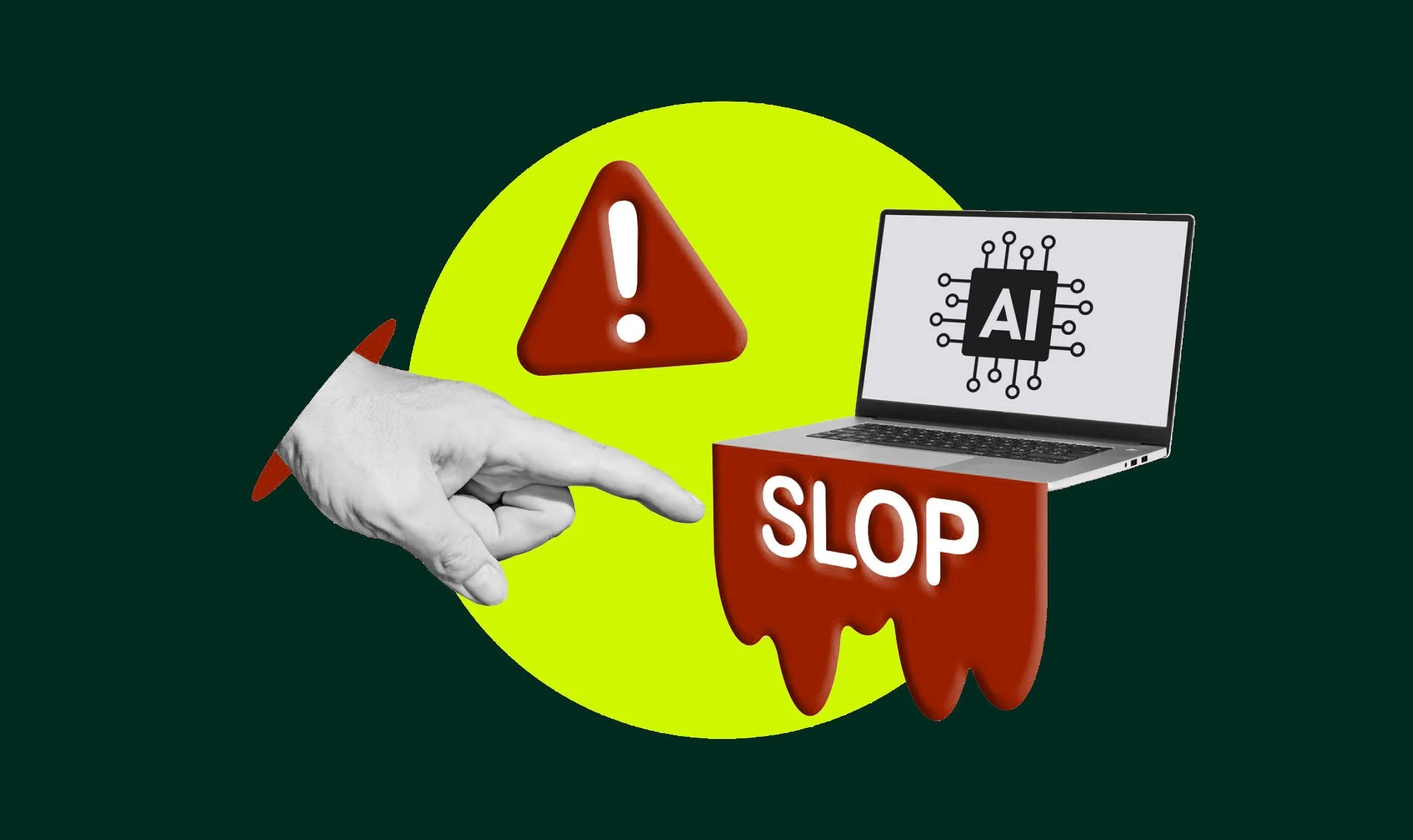
The phrase “AI slop” has emerged to describe the tidal wave of low-effort, mass-produced AI content flooding digital channels.
The Guardian described “slop” as the latest wave of AI-driven material pushed online at scale, often designed to capture attention rather than serve readers. The concern is not simply about quality, but about the erosion of authenticity across the web.
Technologist Simon Willison, who helped popularise the term, has drawn a sharper line. Publishing unreviewed AI-generated content, he argues, is simply bad behaviour. The issue is not the tool. It is the absence of responsibility.
For B2B brands, that distinction is critical.
When Scale Outpaces Standards
AI has reduced the cost of content production to near zero. That has changed behaviour
More landing pages.
More “insight” articles.
More automated outreach.
More campaign variations.
At first glance, much of this output appears credible. Structurally correct. Tonally acceptable. Plausible. But buyers are noticing a shift, and brands are starting to realise that this is a zero-based game of sh!t in equals sh!t out.
Accenture’s Life Trends research highlights that trust is becoming a defining factor in how people engage with brands, with a majority of respondents questioning the content they are served online more than before. Suspicion is rising. Scrutiny is increasing.
At the same time, research reported by ITPro found that 68% of respondents expressed low confidence in how businesses use AI in customer interactions, particularly when automation replaces meaningful human support.
In consumer markets, the backlash is already visible.
Some brands have publicly committed not to use generative AI models in place of real people, positioning the move as a values and trust decision. Others have faced criticism when AI-driven creativity clashed with perceptions of craftsmanship and quality.
The lesson is clear. When automation undermines authenticity, brand equity suffers.
The B2B Version of the Problem
In B2B, AI slop rarely looks absurd. It just looks generic.
A whitepaper full of recycled phrasing and no proprietary insight.
A LinkedIn thought leadership post that reads like every other.
A case study that offers claims without operational detail.
A website that sounds polished but interchangeable.
This is where the real damage occurs. Not viral outrage. Quiet erosion.
B2B buying cycles are long. Committees are large. Decisions are high stakes. When your content feels indistinguishable from competitors, it becomes easier for buyers to default to price, incumbency or peer recommendation. Worse still, copies from new entrants into your market get an easy foothold as your trust and credability has already been eroded.
Platforms are responding. The Associated Press has reported on moves by major platforms such as TikTok to label AI-generated content and adopt content credentials systems. Transparency and provenance are becoming part of the infrastructure of digital communication.
That should prompt an uncomfortable question for marketing leaders. If your content were clearly labelled as AI-assisted, would it strengthen or weaken your brand
Furthermore, when platforms such as Meta and X are awash with such content, why would a respectable brand leverage these channels so heavily as risk being branded as more of the same?
The Competitive Advantage of Craft
Ironically, the flood of AI content creates an opportunity.
When generic output becomes the norm, well-crafted thinking stands out more sharply. When templated messaging dominates feeds, distinctive voice becomes more valuable and when surface-level insight is everywhere, deep sector understanding becomes rare and powerful.
In complex B2B sectors, buyers are not looking for volume. They are looking for clarity.
They want partners who understand their world, speak their language and respect the commercial realities they operate within. That cannot be faked convincingly for long.
To be clear, I’m not slating AI for the sake of it or to sell more creative hours!
You’ve heard it before, AI is a powerful new tool that can assist research, accelerate drafting, streamline workflows and when used well, it can improve efficiency and free teams to focus on higher value thinking. But it’s a tool first and foremost.
It cannot replace:
Genuine market interrogation
Hard strategic choices
First-hand industry knowledge
Accountability for claims
Creative judgement and craft shaped by years of experience
Those remain human advantages.
Now is the moment to audit your standards.
Move from “good enough at scale” to “distinctive and defensible”
We Help B2B Brands Stand Out
At Wrapnwe specialise in helping B2B brands in complex industrial, construction and manufacturing sectors replace noise with clarity.
Our approach starts with strategic consultancy. We interrogate where your brand sits, where genuine opportunities lie and how you can position yourself clearly and credibly in demanding markets. Strategy is not an add-on. It is the foundation.
We underpin that thinking with rigorous research, data and insight. Competitor analysis, customer research, brand perception studies and performance analytics ensure that your messaging is built on evidence, not assumptions.
From there, our creative services translate strategic clarity into work that commands attention and earns respect. Campaign development, brand identity, copywriting and design are crafted specifically for technical audiences who value substance as much as style.
Our photography, videography and animation teams produce high-quality visual content built around clear commercial objectives. Our social and digital marketing programmes focus on commercially meaningful outcomes rather than vanity metrics, supported by engaged user analytics that measure real value.
We design and build high-performance websites and digital platforms engineered around strategic UX, distinctive design and robust development, ensuring your digital presence strengthens credibility at every touchpoint.
All of this is delivered through a consultative, fit-for-purpose model that gives you access to experienced B2B specialists without the overhead of a traditional agency structure. The right resource, at the right time, with a single point of accountability.
Raising the Bar, Not Lowering It
The “AI slop” wave is not a temporary glitch. It is a structural shift in the content ecosystem, as predictable as the swing of a pendulum.
For B2B brands, the response should not be fear. Nor should it be blind acceleration. It should be discipline.
Now is the moment to audit your standards. To interrogate your positioning. To ensure that every asset you publish earns its place in your buyer’s journey. To move from “good enough at scale” to “distinctive and defensible”.
Because in a world saturated with synthetic sameness, credibility has become the ultimate differentiator and your opportunity to grab market share from your competitors.
In an era defined by AI acceleration, our role is simple.
To help B2B brands think more sharply.
Communicate more clearly.
Create work that cuts through.
Build trust that lasts.